Dear Moderator,
This is my epic finished blog, I hope that you enjoy reading it. I have links to both of my teachers, and the other members of my group, Alex Thoupos's and James Reader's blogs on the right of my blog. Hopefully it will be easy to navigate between the all the blogs.
On my blog, you should find pieces of evidence of Research, Planning, Production and Evaluation. You will see my prelim task video and final opening sequence at the top of my blog.
Thank you for taking the time to read my blog
Hope you are well,
Matthew Smith (3745)
Wednesday, 6 April 2011

Tuesday, 5 April 2011
1. In what ways does your media product use, develop or challenge forms and conventions of real media products?
Our film 'Cataclysm' is an Action Horror film, set in the days and weeks after a deadly radiation leak has affected all surrounding towns and cities and resulting and many people dying. The army is called in to assess the situation, calculate the death tolls and evacuate all those fortunate enough to survive the ordeal. However, unknown to the army, some people took in so much radiation that they became mutated, feeding on the flesh of those still walking. Sgt. Murray, despite his low rank in the army, prevails as the lead in this operation and battle against the mutants.
Our opening sequence needed to clearly convey our sub-genre of Action Horror and due to it being a very specialised genre, we needed to follow and use conventions of real films and opening sequences to make it apparent what our genre is right from the start. The only other film that we could think of that fits into the same genre as our film is I Am Legend
(Lawrence
As in the trailer above, from 1:10-1:12, there is a sense of the unknown, where you can hear the noises of the beast, but can't see it. This is a very typical convention within Horror and Action films and is something the audience is used to seeing. This helped us a lot as not only could we build up tension and follow form very easily, but it allowed us to avoid including an actual sighting of the antagonist.
Another film that I found influential was Green Zone (Greengrass, 2010). A scene from the opening sequence features many of the characters gearing up in army gear and gas masks. This triggered the whole idea of our film and helped us come up with the idea for it.

The sound used in our sequence was key to keeping our sequence within the genre that we wanted it. The tension building soundtrack, consisting of drumbeats, acoustic and choir voices, was the key element that we used to create a foreboding atmosphere and stick to conventions. This caused the audience to expect something to happen, but not be able to work out what, still keeping the element of surprise.
When we were shooting, although we needed to stick to conventions, we also wished to break the traditional conventions of darkness within horror products and used an environment that was bright, outside and sunny. This broke the typical form of a horror film and therefore, shows to the audience that there is something different, but as said above, the music still emphasises the genre. Although the location we used was open, the effect we used to wash out our shots cancelled the colour of the sky, however, it is still open and bright.

Todorov’s narrative structure theory shows a progression in the movement from equilibrium, to disruption and then back to equilibrium. It is applicable to our opening sequence. Below is a diagram of his theory, and how I applied it to our opening sequence.
Todorov
Levi Strauss's theory of binary opposites definitely applies to our opening sequence. The binary opposites that appear within our opening sequence are:
Propp's character theory is applicable to our film as a whole, but only a couple of the characters are in the opening sequence.


Our opening sequence needed to clearly convey our sub-genre of Action Horror and due to it being a very specialised genre, we needed to follow and use conventions of real films and opening sequences to make it apparent what our genre is right from the start. The only other film that we could think of that fits into the same genre as our film is I Am Legend
(
As in the trailer above, from 1:10-1:12, there is a sense of the unknown, where you can hear the noises of the beast, but can't see it. This is a very typical convention within Horror and Action films and is something the audience is used to seeing. This helped us a lot as not only could we build up tension and follow form very easily, but it allowed us to avoid including an actual sighting of the antagonist.
Another film that I found influential was Green Zone (Greengrass, 2010). A scene from the opening sequence features many of the characters gearing up in army gear and gas masks. This triggered the whole idea of our film and helped us come up with the idea for it.

The sound used in our sequence was key to keeping our sequence within the genre that we wanted it. The tension building soundtrack, consisting of drumbeats, acoustic and choir voices, was the key element that we used to create a foreboding atmosphere and stick to conventions. This caused the audience to expect something to happen, but not be able to work out what, still keeping the element of surprise.
When we were shooting, although we needed to stick to conventions, we also wished to break the traditional conventions of darkness within horror products and used an environment that was bright, outside and sunny. This broke the typical form of a horror film and therefore, shows to the audience that there is something different, but as said above, the music still emphasises the genre. Although the location we used was open, the effect we used to wash out our shots cancelled the colour of the sky, however, it is still open and bright.

Todorov’s narrative structure theory shows a progression in the movement from equilibrium, to disruption and then back to equilibrium. It is applicable to our opening sequence. Below is a diagram of his theory, and how I applied it to our opening sequence.
Todorov
Levi Strauss's theory of binary opposites definitely applies to our opening sequence. The binary opposites that appear within our opening sequence are:
- Known vs. Unknown - This is most probably the biggest pair of opposites within our opening sequence. The most obvious example of this is the Soldier and Forensics against the beast. We have close ups of the characters, but only ever see the beast's POV. Another example of this is the first 20-30 seconds of the opening sequence. The soldier is unknown at this point, due to the gas mask and helmet but the once removed, we get close ups of his face. Again, this is something that is in most, if not all, horrors.
- Silence vs. Loud - Although we have a soundtrack playing throughout the whole opening sequence, there are parts when it is quiet and these completely contrast with the drumbeats towards the end of the opening sequence.
Propp's character theory is applicable to our film as a whole, but only a couple of the characters are in the opening sequence.
- The villain who struggles against the hero - In our opening sequence, it is the beast. However, in our whole film, the whole group of mutants are the villains.
- The dispatcher who sends the hero off - The commander who our main character speaks to in the opening sequence through the radio works as the dispatcher in our film.
- The helper who helps the hero in the quest - This would be the fellow soldiers who also fight in the battle against the mutants.
- The princess who the hero deserves throughout the story - In the evacuation of the surronding towns, the soilder meets a young girl called Elizabeth who is taken by the mutants as a way of hostage.
- The father who gives the task to the hero - This is not clearly distinguished in our film, as it isn't in most other films either.
- The donor who prepares the hero - As with the father, this isn't clearly distinguished in our film.
- The hero who seeks equilbrium - This is Sergant Murray, the soldier who prevails in the fight against the mutants.
- The false hero who take credit for the hero's actions - The soilder in the opening sequence can be seen as the false hero as we would expect him to be main character before he is killed.

2. How does your media product represent particular social groups?
Our opening sequence used the typical conventions of a strong British Soldier. We needed to convey that he was emotionless, strong, demands respect and enforces power. We attempted to express these through the following:-
Scripting – We used the little dialogue that we have in our sequence to give the audience an insight into the characters personality and the way in which he runs things. We decided to show him bossing the less authoritative forensics around. We also showed the forensics to be very down to the point, speaking in official terms and only speaking when necessary, which shows that it is just a job to them and that they are lower down in the social hierarchy, unlike the soldier who speaks into his radio to another officer.

Costume – As the soldier is the main character in the opening, we needed to make sure that his costume made him instantly recognisable as a soldier. We achieved this by using a camouflaged outfit and boots. We also used costume to signify that the forensics are forensics by having them wear full overalls and masks.

Props – As with costume, we needed to make sure that the soldier is instantly recognisable as a soldier so we used the gun and the helmet to allow the audience to see straight away what he is.

Action - The shooting of the unknown person within 30 seconds of the opening by the soldier shows his lack of emotion and that he is quick to make decisions, 2 typical traits of soldiers in films.

Our sequence doesn’t really include many social groups as. However, as the main character is male, which is generally seen as strong and build for the role of a soldier. This was basically a necessity for our film to make sense as there is a universal image of soldiers and we needed to conform to this to make it obvious.

Scripting – We used the little dialogue that we have in our sequence to give the audience an insight into the characters personality and the way in which he runs things. We decided to show him bossing the less authoritative forensics around. We also showed the forensics to be very down to the point, speaking in official terms and only speaking when necessary, which shows that it is just a job to them and that they are lower down in the social hierarchy, unlike the soldier who speaks into his radio to another officer.

Costume – As the soldier is the main character in the opening, we needed to make sure that his costume made him instantly recognisable as a soldier. We achieved this by using a camouflaged outfit and boots. We also used costume to signify that the forensics are forensics by having them wear full overalls and masks.

Props – As with costume, we needed to make sure that the soldier is instantly recognisable as a soldier so we used the gun and the helmet to allow the audience to see straight away what he is.

Action - The shooting of the unknown person within 30 seconds of the opening by the soldier shows his lack of emotion and that he is quick to make decisions, 2 typical traits of soldiers in films.

Our sequence doesn’t really include many social groups as. However, as the main character is male, which is generally seen as strong and build for the role of a soldier. This was basically a necessity for our film to make sense as there is a universal image of soldiers and we needed to conform to this to make it obvious.

3. What kind of media institution might distribute your media product and why?


On the other hand, it may be better for us to distribute through a large American distribution company such as 20th Century Fox or solely Universal. They have the funds and contacts to make our film an internationally, if not globally, appreciated film which appeals to a much broader target audience, therefore increasing revenue and success. Taking both of these into account, we would be more likely to wing towards the big American distributor as we don’t wish for our film to be limited to a smaller market and wish for it to be appealing to a large number of people which is do-able due to the unique, yet attractive genre.

4. Who would be the audience for your media product?
Our target audience is 15-24 males with a secondary audience of 15-24 females and 25-40 unisex. Our film has an age rating of 15 and therefore, we are not targeting but are still attempting to appeal to anyone under this age.

Name: David Baxter
Age: 17
Gender: Male
Nationality: British
Media Appeals: Horror, Comedy, Action, Adventure
General Likes: Sports, Friends, Gaming
Regular Cinema-goer: Yes, 2-3 times a month
We chose to have this target audience as we know the majority of teenage boys and young adults enjoy horrors and most definitely like a lot of action. This is also a rather large and broad target audience, with a large percentage of the British population within this age range, meaning our film is most likely going to appeal to a large amount of people.
 We chose to have a secondary target audience of 15-24 year old females and 25-40 year old unisex. This is due to there being a the majority of both sexs within this age range, again meaning we are appealing to a large amount of people.

Name: David Baxter
Age: 17
Gender: Male
Nationality: British
Media Appeals: Horror, Comedy, Action, Adventure
General Likes: Sports, Friends, Gaming
Regular Cinema-goer: Yes, 2-3 times a month
We chose to have this target audience as we know the majority of teenage boys and young adults enjoy horrors and most definitely like a lot of action. This is also a rather large and broad target audience, with a large percentage of the British population within this age range, meaning our film is most likely going to appeal to a large amount of people.

5. How did you attract/address your audience?
Mostly the people who go to watch our film are going to be fans of the horror genre and therefore will automatically like our film opening due to the typical conventions of a horror film that we have included. This was our way of attracting our audience. We attempted to draw on film plots and action that we knew our audience liked and put them into our opening sequence.
The conventions that are in films that inspired us, such as I Am Legend, are also in our film. As this film was a massive success, and most definitely appealed successfully, using similar conventions and forms will appeal and attract our audience.
We screened our opening sequence to friends and teachers and asked them to fill out a questionaire. Below is a video of our screening, and a sample of a typical questionaire that we recieved.

In general, our questionaire was positively filled out, with an average score of 8 and the improvements were mostly about the acting in our sequence, which we knew wasn't a strong point for us.
 |
| The blood and gore of this shot helps the audience instantly recognise the genre of our film. |
 |
| The montage section of grabbing the gun, walking forward into focus and walking past the camera with the boots gave the sequence more pace and is a typical convention of horror films. |
The conventions that are in films that inspired us, such as I Am Legend, are also in our film. As this film was a massive success, and most definitely appealed successfully, using similar conventions and forms will appeal and attract our audience.
We screened our opening sequence to friends and teachers and asked them to fill out a questionaire. Below is a video of our screening, and a sample of a typical questionaire that we recieved.

In general, our questionaire was positively filled out, with an average score of 8 and the improvements were mostly about the acting in our sequence, which we knew wasn't a strong point for us.
6. What have you learnt about technologies from the process of constructing this product?
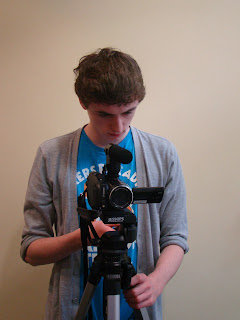
For our technology during production, we used a lot more than just a camera. Here is a picture and description of what we used:-

Hardware
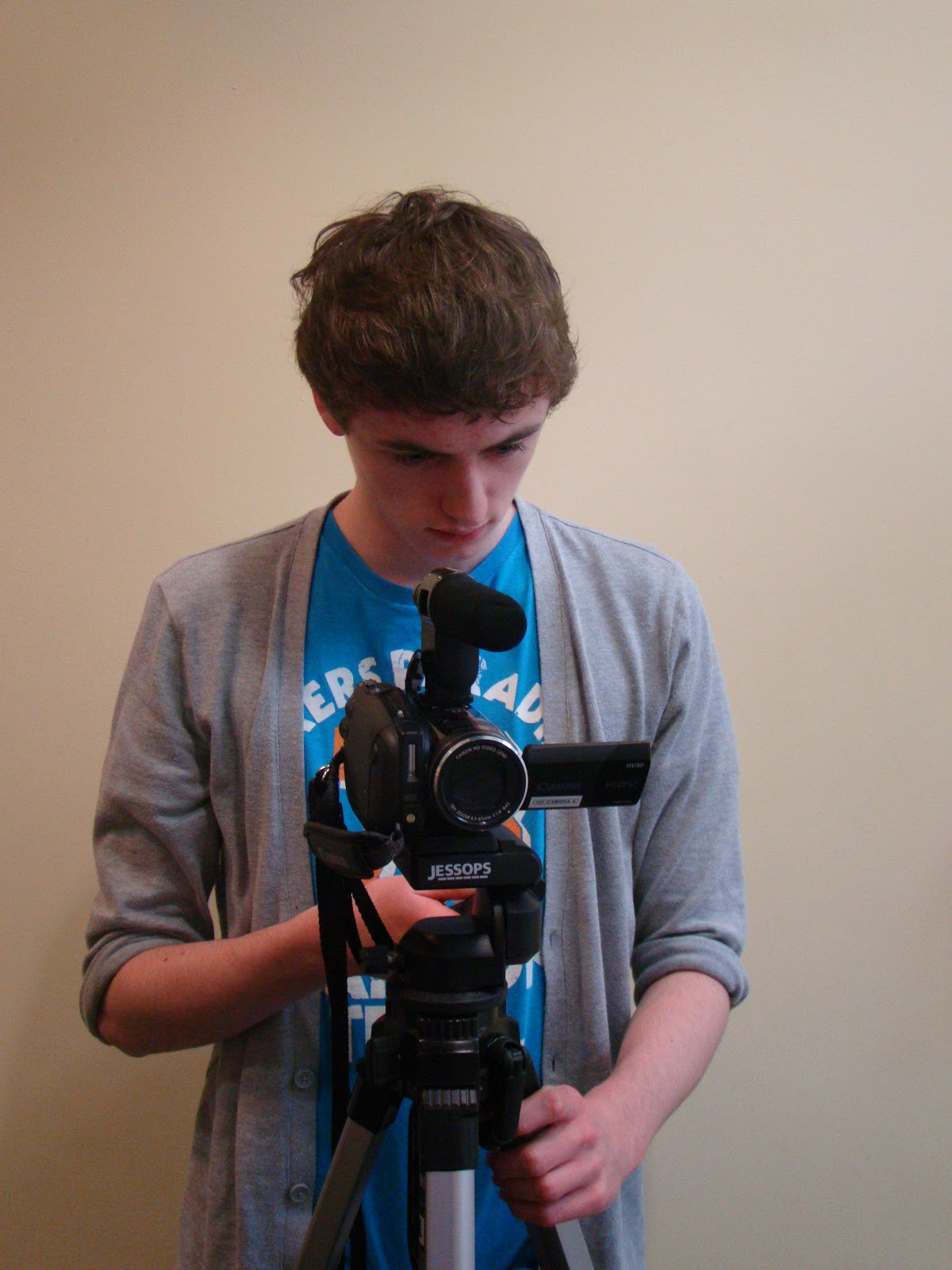
- Canon HV40 – This is the video camera that we used for shooting our sequence. It is a HD camera, however, we shot in SD. Since the beginning of the project, I have learnt how to change focus manually, and how to do focus pulls. It was very helpful as it is lightweight, very easy to transport and simple to use.
- Sony Mini DV Tape – This is the tape that we used to shoot our feature. They are 1 hour each in length, and we used 3 of them throughout the whole of our shooting.
- Tripod – Although many of our shots were handheld or foot height, we used the tripod for the pans, and the close-ups of people talking.
- Shotgun Microphone – As we were muting the majority of our shots, we only needed the microphone for the dialogue, on which we had the microphone on the setting ‘Shotgun’ which is best for dialogue as it picks up sound from mostly what is just in front of the microphone.
- Headphones – This allowed us to see if there was a lot of background noise. Although we used it during all shots, it was only really necessary during the shots for which we were keeping the sound.
Hardware
- Dell Computer w/ Cibox duel screen monitors – The dual monitors allowed us to view on the right screen the output, whilst edit the shots on the left screen. This saved a lot of time which would have been lost between switching screens of having it all on one screen.
- Microphone – We needed to dub a little bit of our sequence, so we used a microphone to get this voiceover and dialogue.
- Apple Macintosh – This was used for the software, iText.
- Adobe Premiere CS3 – This is the biggest piece of software that we used as it is what we used to edit all of our sequence.
- Adobe After Effects – We used this for the gunshot as it was a lot easier to edit it there, rather than Adobe Premiere CS3.
- Action Essential Pack 2 – This was the action pack that we used to get the blood splats and the muzzle flares used to create the effect of someone being shot.
- iText – The titles from our sequence were created on this program.
7. Looking back at your preliminary task, what do you feel you have learnt in the progression from it to the full product?

Tuesday, 15 February 2011
Final Script
Cataclysm
1. EXT. RESIDENTIAL STREET, NORTH LONDON - EARLY MORNING
Opening shots of empty residential area, nobody around. As shots change we get closer to the house on the end of the road, where two forensic officers can just be seen in the distance. Text appears on screen during shots:
London. 2015. The City is a code black location after a radioactive gas leak.
Many parts of London evacuated. Army now in control.
Estimated dead: 7,000,000 and counting
Shots are now close enough so that you can see the forensic officers in the distance checking a dead body. One of them is taking notes on a clipboard; the other one is taking pictures of the body.
Cuts to a foot level shot of a soldier on the street. Soldier pokes at a body with his gun then walks on, camera follows with a forwards track. Cuts to POV of the soldier looking around the street. You can see the forensics more clearly now checking the body and there is another body which is in the street.
Parallel cuts with establishing shot of soldier and forensics on the street. As soldier approaches the forensic officers, he coughs loudly to grab their attention. As he walks towards them it goes to a shot-reverse-shot of the conversation.
Soldier: What’s the sit rep?
Forensic 1: This is the last street we need to check in this area. There’s 15 dead including the 2 on this street and there’s one more just inside the gate there (points towards gate)
Soldier: Have you checked it?
Forensic 2: No we haven’t had time
Soldier: Go check it now then
Forensic 1: But sir, we have to finish this one...
Soldier: Just go!
Forensic 1&2: (begrudgingly) Yes, sir
The forensics walk towards the gate. Cuts to a POV shot of the ‘beast’ watching them from the corner of the garden. He watches them as they closer to the body, as they approach cuts to a LA close up of them crouching down by the body with the camera and clipboard.
Forensic 1: Right then, who do we have here?
Forensic 2: Young female, possibly early teens. Chemical scarring...
Forensic 1: On the right forearm perhaps?
Forensic 2: Of course, just like the others
Forensic 1: Take a picture and then let’s get out of here
Forensic 2: Wait a minute, here on the left wrist and neck, these haven’t been on the other bodies.
Cuts to close ups of teeth and claw marks on the left wrist and neck. Forensics look at each other, the Forensic 2 gets his camera to take a picture of the wounds. Forensic 1 turns towards the soldier and calls to him but the soldier raise his hand.
Soldier: (into radio) Yes sarge. There’s 15 dead here... Area Omega... North London... Just checking the final body now...
Cuts back to forensic officers.
Forensic 2: Where’s sir?
Forensic 1: He’ll be a minute, he’s on the radio to base
Cuts back to soldier.
Soldier: (still into radio) all seem to be from the gas sarge, chemical scarring... no there’s been no problems to report... we’ll be back to base...
(Screams heard in background)
Soldier spins quickly looking slightly shocked. Close up montage of the soldier grabbing gun and walking towards the gate. As he enters there is a close up of him looking down at the floor shocked, and he momentarily lowers his gun and walks towards the bodies. Cuts to a POV shot of him looking at the bodies of the girl and now the two forensics as well. Cuts to the ‘beast’ again, watching the soldier. He moves around the wall and snaps a twig. The soldier turns and instinctively fires towards the corner of the garden.
He then realises thinks there is nothing there so he backs away, looking around. The camera tracks towards him as the ‘beast’ and then goes into ECU of the soldier looking scared.
Cut to black.
Sunday, 13 February 2011
Shot Report of First Shoot
Today was our first day of shooting, and it went rather well. We managed to get most of the shoots that we wanted to get done. Saying this, there were a few mishaps which we will be addressing later on in the week during editing and see if we can edit in a way so as to get away with the footage we have taken.
Cataclysm Shot Report
Monday, 24 January 2011
Stalker - Initial Idea
This is my personal sequence that I came up with. I then gave it my group, who all liked the idea, and after my explanation, agreed that it was plausible. I didn't come up with a name for the film when storyboarding, but I do like the name 'Stalker' for this sequence.
The sequence opens with man waking up from lying on the floor. He is wearing full forest camo, with battle packs. He picks up a gas mask next to him and puts in on before picking up an M16. He proceeds out of the room cautiously, moving down corridors into a large room, full of rubble, upturned tables smashed windows. He spots a door and heads over to it, poking his head out of the window. He spots 2 people wearing gas masks, in full forensic clothing, walking slowly down the corridor, looking at giager counters. The army man takes cover as they walk past, and follows them as they enter another hall. They continue to a back room, whilst the army man explores the hall. Gunshots go off at the back, followed by screaming. The armed man proceeds to the back room to see the 2 forensics lying on the floor, covered in blood. He hears a noise back in the hall, so spins on the spot, and open fires his gun before realising there is nothing to be seen, puts his gun on his back and removes a pistol from his holster. He walks towards to door, gets there, then hears a running noise behind him, and the scene concludes with the ‘beast’ leaping towards his face.
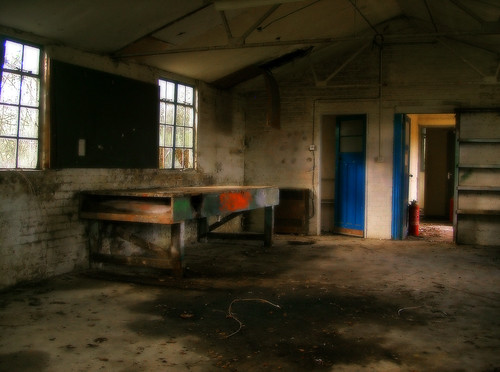 |
| A picture of the inside of Thurleigh Ex-RAF site |
Although this sequence sounds rather implausible, we had every aspect of it planned out. The props such as the gun and masks would have been provided by me. I own masks that could be passed for gas masks, and the gun would have been an unloaded, completely safe replica M16 paintball marker. The location had been found, and a deserted and abandoned RAF site in Thurleigh, Bedford, which is no longer owned by anyone and therefore open for anyone to enter and look around. After looking at some pictures, we really liked this location and as it were accessible and not too far away, we were going to use this. It would have been perfect for our sequence, as it is run down, and has a ‘haunted’ look about it. However, after more research into the location, due to it being no longer owned, it has become home to many squatters and I no longer felt alright about taking 4 people and myself, along with hundreds of pounds worth of equipment to a site which could be possibly dangerous. Although I really liked this idea, I put it to one side, and moved on with other ideas and possibilities.
Wednesday, 20 October 2010
Preliminary Exercise Evaluation
1) Who did you work with and how did you manage the task between you?
I was in group 3E, and in my was Adam Romo, Daniel Sheldon, and myself, Matthew Smith. Below is a picture of our group.

We split the roles up equally. We all contributed and put in equal effort into storyboarding, creating ideas and planning our shooting. As we only had 3 people in our group and Adam and myself were actors in our sequence, Daniel was camera and sound man for most shots. I filmed the one shot in which I was not in (0:07-0:09) but apart from this shot, Daniel filmed the whole sequence. Adam and I balanced this out by taking a more dominant role whilst editing. Adam's job was to capture all shots filmed and transfer them onto the timeline. He then split these into the different shots and alternated them between Video Track #1 and Video Track #2. My job was to make a rough cut, getting rid of all 'Actions' and 'Cuts' and ordering shots. Then Daniel's job was to fine cut all shots and make sure the continuity was fine in regards to match-on action. I feel this worked really well, and we all feel that we spread the work out evenly.
2) How did you plan your sequence? What processes did you use? What theories did you try to take into account?
When we first planned our sequence, we jumped straight into storyboarding the below sheet. We came up with a quick, rough storyboard that gave our whole group an idea of what was happening and a chance to input ideas. We worked out the storyboard very easily, as we had easy access to our set, so each of us stood up and explained a part of a sequence was, pretending we were the camera, and acted it out. This made the whole thing very visual and made storyboarding easy and quick.

The above is our storyboard. We stuck by it almost completely and used this, aswell as the below shooting schedule to help us when filming. The only changes we made to this storyboard was shot 3 and shot 7. Shot 3 was changed to look like shot 4, and became a mid, over the shoulder shot with the camera on me over Adam's shoulder. Although we changed this shot, it was still acting as the reaction shot that was part of the brief. Shot 7 was changed to look like shot 8, as a master, wide shot. We also added in a shot 9 and 10. Shot 9 was from inside of the room of the bully closing the door, and shot 10 was exactly the same shot as shot 8.
We are able to apply Levi-Strauss' theory of binary opposites to our sequence. Good vs. Evil is one of them. The nerd is the good as he has done nothing wrong and the bully is the evil as he is 'stealing'. Innocent vs. Violent is another binary opposite. The nerd is innocent, despite his reaction, and the bully is violent as he roughly chucks the nerds books onto the floor.

We are also able to apply Barthes' 5 codes to our sequence:
- Engima - Who is the bully? What has he been doing to the nerd? Why does the nerd go crazy? How long has it been going on for? What has happened in the past?
- Action - The bully (antagonist) throws the nerds' (protagonist) books on the floor, and then the nerd flips out and shouts "I'm fed up with you pushing me around!!" The tone of both of their voices help the audience quickly establish who is the protagonist and the antagonist.
- Semiotic - The high angle/low angle shots make the bully look superior and the nerd inferior which is vital in our sequence. The clothing of the bully makes him seem intimidating as he is wearing a hoodie, a piece of clothing that is strongly associated with disruptive, poor adolescent behaviour.
- Cultural - The title sequence, and the name of our sequence, NERD, puts the audience in the mind set of a bullying situation, which works in our favour.
- Symbolic - Due to the length of our sequence, it doesn't contain anything that is obviously symbolic.

Above is a picture of myself using all of the equipment that we had available for our production. When filming, we used a Canon HD Video Camera, with an attached Shotgun Microphone ontop. We didn't record in HD however. The Shotgun Microphone had 3 settings; Shotgun, 1 and 2. Shotgun was used for our conversation shots, as it gives the clearest sound settings when the subject is directly infront of the camera. Mode 1 was a little bit wider, allowing us to hear more background noice, which we used for our master shots. Mode 2 was very wide, and all surrounding sounds could be heard. We didn't use this mode at all. We were provided with Sennheiser headphones which allowed us to make sure the sound was alright before we started filming.


As you can see above, we were also provided with a clapperboard, and a tripod. We used both of these in all shots.
When it came to editing, we used a Dell Optiplex computer with Windows XP operating system. The program we used was Adobe Premiere Pro. This program was highly sufficient for the type of editing that we needed to do, and it allowed us to order, cut and finely adjust our sequence so that it was understandable for the audience.
4) What factors did you have to take into account when planning, shooting and editing?
When we were planning, we had to consider implementing all elements of the brief, which was:
- Continuity task involving filming and editing a character opening a door, crossing a room and sitting down in a chair opposite another character, with whom she/he then exchanges a couple of lines of dialogue. This task should demonstrate match-on-action, shot/reverse shot and the 180-degree rule.
Post-production was the area in which we had to pay most action to the footage we have captured. Although we couldn't go back and film anymore, we had to make sure there was no continuity errors, that our sequence made sense, and that the match-on-action made our sequence believable and realistic. When editing, we did notice that a few of our shots wouldn't fit into our sequence because the continuity would be ruined. We attempted to put in a better reaction shot, but it didn't work well and in the end, we took it out. The match-on-action between shot 1 and shot 2 was one of the shots that we needed to get correct so that it would flow well and we all feel that it was perfect timing. Below is a picture of Adam and Daniel at our editing studio working on our project.

5) How successful was your sequence? Please identify what worked well, and with hindsight, what would you improve / do differently?
I personally feel that our sequence did the job it was meant to do, and that we successfully acknowledged and met all of the parts of the brief. However, there are both pros and cons in our sequence.
The pros are that we managed to implement all the necessary requirements that were established in the brief. We were able to maintain good continuity techniques. We followed the 180-degree rule, achieved successful match-on-action, and used shot/reverse shot well, and overall, I believe we produced a high quality final product. The cons are that the storyline of our sequence isn't awfully original or unique, and is very simple. This means that the audience may be a little bit bored when watching it, but as the brief of the project was to include all the techniques, this was necessary.
In hindsight, I would make sure that we spent less time re-shooting shots and try to get a wider variety of shots filmed. This way, we could make our sequence a little bit longer, whilst still including all the continuity techniques and allowing a better narrative to be established. I also feel that we could of used some better angles, and shots like the one below are rather plain and get boring if used too much.

6) What have you learnt from completing this task? Looking ahead, how will this learning be significant when completing the rest of your foundation coursework, do you think?
From completing this task, I have learnt that it is always important to plan ahead of schedule and make sure that what you are doing is time efficient. I have also developed skills such as team-working, creativity and technological skills. These will all help when completing the rest of my foundation coursework. I hope the understanding that I have gained from this task will help me when it comes to creating a 2 minute opening sequence, and I believe that it will help me.
Friday, 15 October 2010
Applying Barthes' Theory to Casino Royale
This is the opening sequence of the 2006 Action Thriller 'Casino Royale', directed by Martin Campbell, featuring Daniel Craig (Quantum of Solace, The Golden Compass) and Mads Mikkelsen (Valhalla Rising, Clash of the Titans).
Enigma (Hermeneutic) Code
- Who is he chasing?
- Why is he chasing him?
- What has he done?
- Where are they going?
- Are these the main to characters?
- Who's the protagonist?
- Who's the antagonist?
- Where is it set?
- What is in his rucksack?
- Where does he get to when he stops running?
The action in this opening sequence is obvious, the chase. It is adrenaline-pumping, full of action and stunts, and leaves the audience sitting on the edge of their seat during the crane in the sky shots. The suspense builds when Bond is surrounded while holding, what the audience is now lead to believe is the antagonist. They believe him to be cornered and out of options, and the audience is wondering what has happened when Bond gives up, but then the action starts up again as he shots the person he was chasing, and explodes the building they were in and escapes.
Semiotic Code
The setting that they are in is a marketplace, with lots of people watching snake charming/fighting, which suggests that they are in a middle-eastern area. This is confirmed during the crane scene as you can see the sun high in the sky, with very hot weather and dirt tracks all around.
Cultural Code
This sequence doesn't contain many cultural codes. However, being a James Bond film, the audience is expecting to see high levels of action and impressive explosions and this is addressed at the end of the opening sequence.
Symbolic Code
All of the scenes in this sequence have quite defined meanings so this code is close to inexistant. The shot of Bond dropping his gun at 8:53 could be seen as a sign of giving up, or that Bond has a different aproach to the situation.
Applying Levi-Strauss' Theory to The Dark Knight
- WARNING: The above film snip-it has a BBFC rating of 15, and is not suitable for viewing of anyone of a younger age.
The binary opposites presented in this opening sequence are as follows:
- Good vs. Evil - This is possibly the most obvious, and frequent binary opposite that appears in all films and is unsubtlely shown in The Dark Knight. This binary opposite helps signify the genre of the film, and instantly, within this opening sequence, allows the audience to gain an understanding of what this film is going to be about. The good is the bank workers, who are taking hostage, and the bank manager who attempts to fight back, who initially looks to be a hero, but then is killed and is proven to be a false hero. The evil is the bank robbers, the masked gunman who kill the 'hero' and break into the vault, making off with thousands of dollars. This sets the rest of the film up to be based around good vs. evil.
- Known vs. Unknown - The criminals rob the bank while wearing masks, and only one of these robbers reveal their identity, the Joker. This shows that this character is unique, and different from the rest. He is the only robber to leave the bank alive, with all the money for himself, which hints to the audience that he set up the heist.
- Calm vs. Anxious - The character that we see as the Joker is calm and controlled throughout the whole scene, whereas all everyone else, not only the hostages, but the other robbers are all on edge, and anxious to get the job done. They work through it speedily, attempting to get the job done as quick as possible. But the Joker, after killing everyone, even has time to go back and put a grenade in the bank managers mouth, showing that he is in control and has everything planned out as he doesn't seen keen to get away from the scene.
- Happy vs. Sad - All the masks worn by the robbers have a frowning 'clowns' face painted on except one. The wearer of this mask is the Joker, which, one again, makes him look unique and the centre of attention. The scars that he possesses which the audience can see when he removes his mask give him a permanent 'happy' expression which is another binary opposite in itself, as he has a happy expression while killing people.


Tuesday, 12 October 2010
Applying Todorov's Theory to 21
Who are the agents: the protogonist and antagonist?
The protogonist is Ben Campbell, the young white male seen cycling through the city and narrating the 'Winner Winner, Chicken Dinner' story. The antagonist, although unknown for the majority of the film, is Micky Rosa, Ben's MIT Professor. The secondary antagonist is Cole Williams, the security manager of the casino that Micky, Ben and the rest of the team hit when travelling to Las vegas. He can be seen as a red herring throughoust the film as despite him being an antagonist, his actions seem miniscule when compared with Mickys'.
Describe the Equilbrium
At the beginning of the opening sequence, a lot of close-ups are used to get a sense of the audience being involved, and instantly draws them into the film. It opens by using a mixture of CGI work, and flashback shots, describing to the audience how they run their operations. The extreme close-up, playing through from 1:22 - 1:26 (actually 2 shots but looks like 1 shot opon first watch) gave me the idea of him getting prepared for something, and the shot at 1:30 confirms this with another ECU of him applying a fake moustache. The black background in these shots make his face look enlightened, and this added together with the framing makes sure the focus is completely on his facial features (binary opposites).
Is the Disruption of Disequilibrium introduced or hinted at?
The phrase "That's what got me into all this mess" sets up the films disruption and the disequilibrium is introduced in a very unsubtle way. "And a hand running through perfect flowing meant only one thing... Get out, get out now." is said while, although unknown to the audience at this meant, Cole Williams, the secondary antagonist mentioned earlier is seen chasing towards the camera, which we assume is from the POV of Ben Campbell. As I have mentioned, this is a red herring. The real disequilbrium is Micky Rosa getting 'revenge' and stealing all of Ben's money, taking back his referral towards Harvard Med meaning he is unable to even qualify for an attempted scholarship and has no money to pay to attend there.
Are there any visual/verbal/aural clues that hint at what the hero's journey might be?
I feel that the sequence of Cole Williams chasing towards Ben whilst he clumisly grabs all of his playing chips hints that his journey may be counting cards to make money as he says that he has made over $600,000 doing what he does.
From your knowledge of the film, how will the equilibrium be restored and what will be the new equilibrium?
The equilbrium is restored by Ben tricking Micky into doing 'one final scam' at which Cole Williams gets Micky back and the chips that Ben has won for his pension. In Cole's last act of kindness, he forces Micky to pay Ben back and re-place his refferal for Ben to get into Harvard. Ben's story of how he counted counts is what makes him 'dazzle' and he gets the scholarship into Harvard Med.
Saturday, 2 October 2010
Applying Todorov's Theory To Disturbia
Who are the agents: the protogonist and antagonist?
The protogonist is Kale, a young white male who propels the story along by attempting to reveal the secrets of the antagonist. The antagonist is Mr
2. Describe the Equilibrium. How is it represented? What kind of camera shots can you identify? (e.g establishing shots to create a sense of space or use of CUs/cutaways to emphasise particular objects/characters faces). Pick out 2 or 3 examples. Describe the mise-en-scene: what meanings to the props/costumes/lighting/framing carry?
3. Is the Disruption or Disequilibrium introduced or hinted at? (e.g the serial killer in "Seven" is introduced in the title sequence).
4. Are there any visual/verbal/aural clues that hint at what the hero's journey might be? (e.g having to solve the murders within a time-limit of seven days in "Seven")
5. From your knowledge of the film, how will the equilibrium be restored and what will be the new equilibrium?
The protogonist is Kale, a young white male who propels the story along by attempting to reveal the secrets of the antagonist. The antagonist is Mr
2. Describe the Equilibrium. How is it represented? What kind of camera shots can you identify? (e.g establishing shots to create a sense of space or use of CUs/cutaways to emphasise particular objects/characters faces). Pick out 2 or 3 examples. Describe the mise-en-scene: what meanings to the props/costumes/lighting/framing carry?
3. Is the Disruption or Disequilibrium introduced or hinted at? (e.g the serial killer in "Seven" is introduced in the title sequence).
4. Are there any visual/verbal/aural clues that hint at what the hero's journey might be? (e.g having to solve the murders within a time-limit of seven days in "Seven")
5. From your knowledge of the film, how will the equilibrium be restored and what will be the new equilibrium?
Wednesday, 29 September 2010
Principles of Continuity
The directors will use many different types of shots for variety, to give the desired effect and for continuity. The main shot used for continuity would be a Long/Wide Shot, generally used to establish a scene. This shot allows the directors, editors and the continuity department to make sure there is nothing changing between shots that shouldn't change.
Continuity Editing
The process that comes from 'Continuity Editing' is calling suture. This is where there audience is metaphorically sewn to the narrative, they begin to believe what is happening in the film to be reality, and forget about real life. This is achieved by the almost 'invisible' editing process as it causes the viewer to forget that they are watching fiction and to enter the parallel world.
Continuity Editing Techniques
This is just a few of the, in my opinion, best continuity editing techniques.
In our lesson today, we were set the task of portraying an accident scene (lowscale e.g. nothing too impressive like car crash or being shot) in 6 shots without the use of editing material. We had to do this by shooting one shot after the other as they would appear in the sequence (if we were to make it properly). This meant that the sequence we filmed wasn't of extremely high standards but it allowed us to, when we watched them back, see some of the errors we made.
Continuity Editing
The process that comes from 'Continuity Editing' is calling suture. This is where there audience is metaphorically sewn to the narrative, they begin to believe what is happening in the film to be reality, and forget about real life. This is achieved by the almost 'invisible' editing process as it causes the viewer to forget that they are watching fiction and to enter the parallel world.
Continuity Editing Techniques
This is just a few of the, in my opinion, best continuity editing techniques.
- 180 degree rule - When filming a two-person-facing shot, the camera must always stay on the same side of the people speaking, so the camera must not cross an imaginary straight line passing through the two characters. It is perfectly fine to film from either side, but once filmed from one side, you must not change as it will give the impression of jumpiness.
- 30 degree rule - Make sure to change the camera angle by more than 30 degrees if using the same composition and framing so as to make give the audience the ability to notice a visible 'jump' in the film. This is known as a jump cut.
- Cross cutting - This is where shots are placed next to either other on the timeline but do not belong together in the narrative sequence. This is useful for showing that two different scenes are happening at once, like a car chase.
- Shot-reverse-shot - This is the cutting between two people having a conversation. A good way to make this sort of sequence not boring is to film it once with a master shot showing both characters, a CU of each character and a BCU of each character. This way, when it comes to editing, it can be mixed up and varied so that the sequence isn't boring and plain for the viewer.
In our lesson today, we were set the task of portraying an accident scene (lowscale e.g. nothing too impressive like car crash or being shot) in 6 shots without the use of editing material. We had to do this by shooting one shot after the other as they would appear in the sequence (if we were to make it properly). This meant that the sequence we filmed wasn't of extremely high standards but it allowed us to, when we watched them back, see some of the errors we made.
- Although we followed the 180 degree rule, the location of our filming was a wide alley, meaning that the walls on both sides is very similar therefore, when we watched it back, the people who hadn't been on our production team thought we had switched the side from which we were filming, and had not followed the 180 degree rule. In future, we would make it alot clearer that we had stuck to the same side.
- We tried to incorperate the 'shot-reverse-shot' technique when filming by including a master shot, a close up and a big close up, however, as we only had 6 shots, and didn't have access to editing materials, we had to do it by hand, so when watching back, it didn't give the right appearance. Saying this, the master shot still did establish the scene. In the future, we would film more takes of each shot, and get more angles in so that we could make our scene a little more interesting.
Tuesday, 28 September 2010
Useful Storyboarding Materials
I have done a web search in an attempt to find some useful storyboarding materials. I have found a few websites which I feel gave me a little more knowledge about storyboarding and the way that storyboards are used to make films successful.
Websites:
These videos show how to storyboard, and contains a well-known storyboarder in the filming industry.
Websites:
- http://accad.osu.edu/womenandtech/Storyboard%20Resource/
- http://www.storyboards-east.com/storybrd.htm
- http://www.storyboards-east.com/sb_coke.htm (This is just a storyboard that I liked)
These videos show how to storyboard, and contains a well-known storyboarder in the filming industry.
Monday, 27 September 2010
P for Psycho


What is happening in the opening sequence of the film?
In the opening sequence of the film, we are introduced to two characters, one who we presume to be the 'psycho' and the other who appears to be a young male. It begins by zooming into the the male toilet door, and then mixes to a low angle of the 'psycho's' legs which has a slow tilt up to the man rubbing his hands. The low angle already signifies superiorness. This is followed by a pan from left to right across various objects such as a belt, a picture frame and a purse/wallet. This cuts to a CU on a plughole with blood flowing down it and then to a CU of the psycho bandaging up his hand, then clenching his fist. This shot tilts up to a close up on his head turning as a boy enters the room. It blurs quickly from right to left and then cuts to a mid shot of the man tucking his gun into his belt. An extreme close up follows of the mans eyes, with underlit lighting. The man says the words "BAD MOVE, KID...", it fades to black, slight pause then 2 single gunshots.
How is the narrative flow established?
The narrative flow is established in the opening sequence through the detail within each of the shots on the storyboard, and the annotations that accompany each frame. The arrows, framing descriptions and descriptions all add up to a successful storyboard and narrative flow. It helps us visualise what we would see, and this helps us come up with our own personal narrative flow.
If you were directing this sequence, what aspects of the storyboard would you like to change?
If I were directing this sequence, I would of used more cuts rather than fades and mixes, especially in the transition between shot 11 and 12. A cut would of been more effective because it would make it more sudden and pacey, therefore adding to the overall effect of someone being shot. If a few more special effects were used, I feel it may of made the thriller genre more obvious, as it may be unclear as of yet what genre the film is.
Subscribe to:
Posts (Atom)